
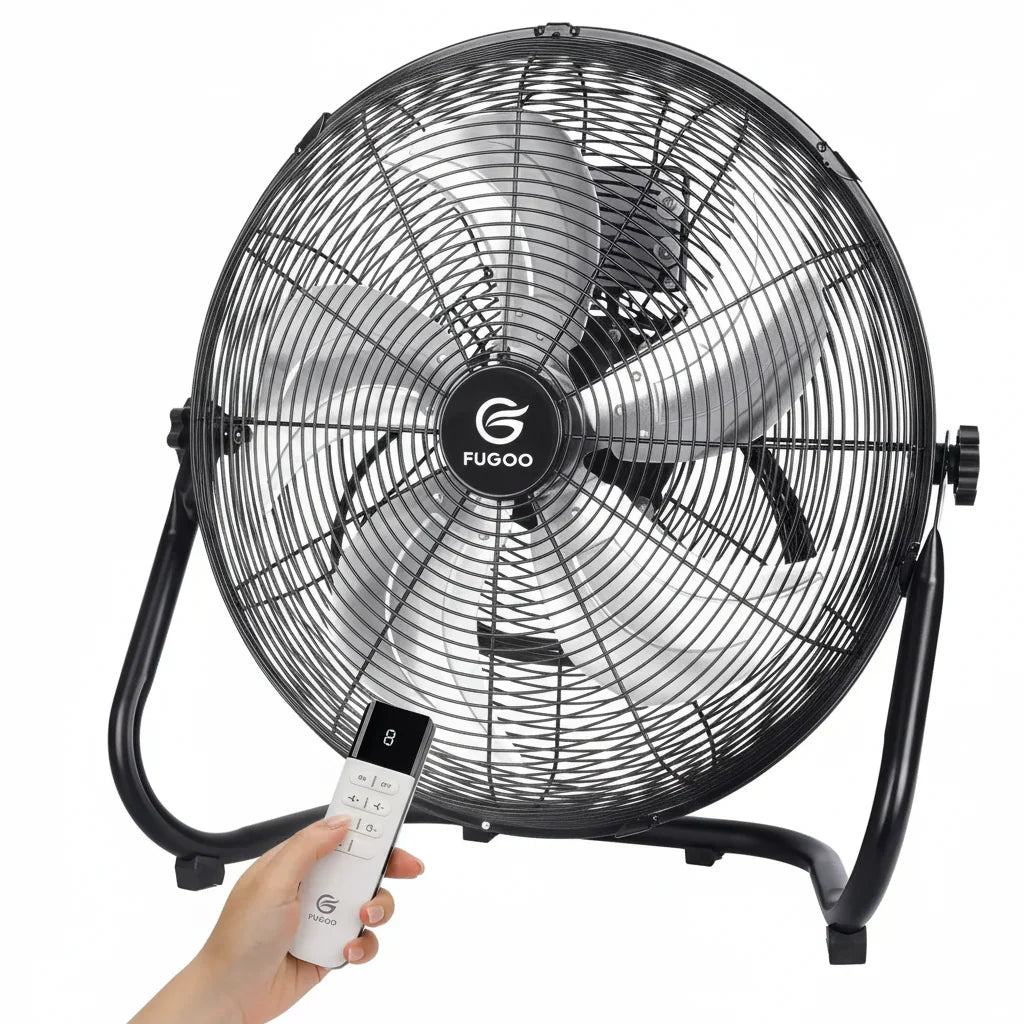
When a room feels hot, stuffy, or slow to dry, a small desk fan may not move enough air to make a meaningful difference. A high-velocity floor fan is designed for larger areas where strong, focused airflow and flexible placement matter.
This guide explains what to compare before buying a floor fan, where this type of fan works best, and how to position it for more effective air circulation.
What is a high-velocity floor fan?
A high-velocity floor fan is a portable fan that sits directly on the floor or another stable surface. Unlike a standard room fan, it is built to move a larger volume of air across a wider space. Its low profile also makes it useful for pushing air along the floor, helping ventilate work areas, or supporting faster drying.
Common applications include garages, workshops, home gyms, warehouses, event spaces, basements, and large living areas.
Six features to compare before buying
1. Airflow capacity
Airflow is often measured in cubic feet per minute (CFM). A higher CFM rating generally means the fan can move more air, but bigger is not automatically better. Match the fan to the size of the room and the job you want it to perform.
- Personal cooling: Focused airflow may be enough.
- Large-room circulation: Look for higher airflow and a wide operating range.
- Drying or ventilation: Strong, directional airflow is especially useful.
2. Motor type and efficiency
The motor affects power use, speed control, noise, and long-term performance. Brushless DC (BLDC) motors are commonly chosen for efficient operation and precise speed adjustment. For a fan that may run for hours at a time, motor efficiency is worth considering alongside maximum airflow.
3. Speed settings
Multiple speed settings give you more control. Lower settings can support everyday circulation, while higher settings are useful for rapid cooling or drying. A wider speed range is particularly helpful when the same fan will be used in both living and work spaces.
4. Adjustable tilt
A tilting head helps direct air where it is needed. Point the fan slightly upward to circulate air through a room, horizontally to create a strong cross-breeze, or downward toward a damp surface when supporting a drying task.
5. Portability and controls
Consider the fan's weight, handle design, footprint, and whether it requires installation. Remote control and touch controls can be useful when the fan is positioned across a large room or in a less accessible corner.
6. Housing, blades, and safety
For garages and commercial spaces, metal housing and metal blades can provide a more rugged construction than lightweight plastic designs. Also check the guard, base stability, power requirements, and relevant safety certification before use.
Where does a floor fan work best?
- Garage: Move warm air toward an open door or improve circulation around a workbench.
- Workshop: Create a directed stream of air without permanently mounting equipment.
- Gym: Improve airflow around training zones and recovery areas.
- Warehouse or commercial space: Support spot cooling in high-activity areas.
- Living space: Supplement air conditioning and reduce stagnant pockets of air.
- Floor drying: Direct air across a cleaned or damp surface to support evaporation.
Floor fan vs. pedestal fan vs. wall-mounted fan
- Floor fans are portable, low to the ground, and easy to aim.
- Pedestal fans deliver airflow from a higher position and may be better for seated or standing occupants.
- Wall-mounted fans save floor space but require installation and are less flexible to relocate.
If portability and directional airflow are the priorities, a floor fan is often the most versatile choice.
A practical example: an 18-inch BLDC floor fan
One current example is the FUGOO 18-inch High-Velocity Floor Fan. It uses a 90-watt BLDC motor and is rated for airflow up to 4,000 CFM. It provides eight speed settings, an adjustable tilt head, remote and touch controls, five aluminum blades, and a freestanding design that does not require installation.
Its 18-inch format is intended for spaces such as garages, workshops, gyms, warehouses, event spaces, and large rooms. Actual performance will depend on placement, room layout, open doors or windows, and nearby obstructions.
How to position a floor fan effectively
- Start with a clear path. Keep the intake and front guard away from walls, curtains, boxes, and loose objects.
- Use cross-ventilation. If outdoor conditions are suitable, aim the fan toward an open door or window to help move warm indoor air out.
- Angle upward for circulation. A slight upward tilt can help mix cooler and warmer layers of room air.
- Aim across damp surfaces. For drying, send air parallel to the floor rather than straight down.
- Test more than one location. Moving the fan a few feet can change airflow dramatically in a room with shelves, machinery, or furniture.
Frequently asked questions
Does a floor fan cool the air?
A fan does not lower room temperature in the same way as an air conditioner. It moves air, which can improve comfort through evaporation and reduce stagnant hot spots.
Is more CFM always better?
Not necessarily. High airflow is useful in large spaces, but control matters too. Multiple speed settings let you reduce airflow when maximum output is unnecessary.
Can I use a floor fan for drying?
Yes, directional airflow can support evaporation from cleaned floors and other damp surfaces. Always follow electrical safety guidance and never place a fan where it can contact standing water.
Can a floor fan replace ventilation equipment?
No. A portable fan can improve air movement, but it should not replace required exhaust systems, filtration, or professional ventilation for fumes, dust, or hazardous materials.
Final takeaway
The best high-velocity floor fan is not simply the model with the largest number on the box. Look for a useful balance of airflow, speed control, motor efficiency, adjustable direction, durable construction, safety, and portability.
For large rooms and work areas, an 18-inch floor fan with a BLDC motor, multiple speeds, and remote control can be a practical, flexible option. Review the specifications and measure your available floor space before choosing.
Share:
Wall-Mount vs Pedestal vs Floor Fans: Which Industrial Fan Is Right for Your Space?
How to Choose a Wall-Mount Fan for Garages, Patios, and Workshops