
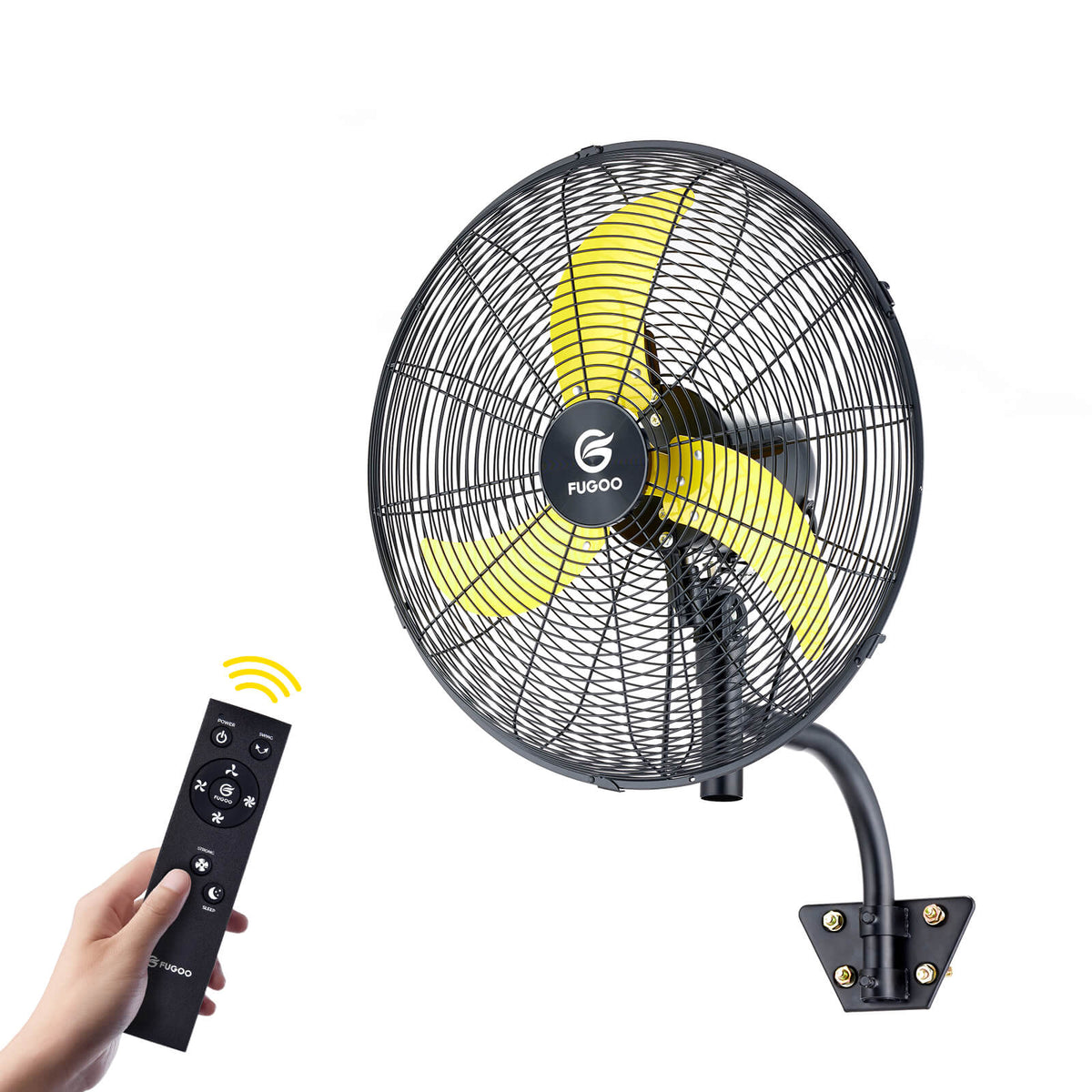
When floor space is limited but a garage, workshop, patio, or commercial area still needs powerful air circulation, a wall-mounted fan can be a practical solution. Mounting the fan above the work zone keeps walkways clear while allowing airflow to reach a wider area.
This guide explains how to choose an oscillating wall-mount fan, how different blade sizes affect airflow, and what to check before installation.
Why choose a wall-mounted fan?
A wall fan is fixed above the floor, so it does not occupy valuable workspace or create another obstacle around tools, equipment, furniture, or storage. An oscillating model can sweep air across a broader zone instead of directing it at only one point.
Wall-mounted fans are commonly used in garages, workshops, warehouses, stores, covered patios, home gyms, kitchens, and other spaces where permanent, elevated airflow is useful.
Seven features to compare
1. Fan size and room coverage
Blade diameter is one of the first specifications to consider. A larger fan can generally serve a larger area, but it also requires more wall clearance and a stronger mounting location. Measure the available space before choosing a size.
- 20-inch: A compact option for bedrooms, home offices, garages, and smaller work zones.
- 24-inch: A balanced choice for larger garages, workshops, stores, and covered outdoor areas.
- 30-inch: Built for large commercial or industrial spaces where maximum airflow is the priority.
2. Airflow capacity
Airflow is measured in cubic feet per minute (CFM). FUGOO's current comparison specifications list up to 4,000 CFM for the 20-inch model, 5,000 CFM for the 24-inch model, and 8,800 CFM for the 30-inch model. Actual airflow in a room depends on fan speed, mounting height, nearby obstructions, doors, windows, and room layout.
3. Motor type and power
A brushless DC (BLDC) motor provides precise speed control and is designed for efficient operation. The three FUGOO wall-fan sizes use different rated power levels: 75 watts for 20 inches, 110 watts for 24 inches, and 160 watts for 30 inches. Compare power consumption together with airflow rather than judging either number alone.
4. Oscillation and tilt
Oscillation helps distribute air across a room, while vertical tilt lets you aim airflow toward the occupied or working area. The FUGOO wall fan provides 90-degree horizontal oscillation and manual vertical adjustment, helping cover more than a fixed-direction fan.
5. Speed and remote controls
Multiple speeds let you use gentle circulation for routine comfort and stronger airflow for hot conditions or busy work periods. The current FUGOO wall-fan range provides four speeds and remote control, so settings can be changed without reaching the mounted unit.
6. Construction and blades
For garages and workshops, look for a stable mounting bracket, a protective guard, and materials appropriate for the environment. The FUGOO models use three aluminum blades and metal construction, which suits spaces where a more rugged fan is preferred.
7. Indoor and outdoor suitability
Do not assume every size has the same weather resistance. FUGOO's comparison page lists IP53 protection for the 20-inch and 24-inch variants, while the 30-inch variant is not listed with that protection. Install any fan under appropriate cover, follow the product manual, and confirm the exact rating of your selected variant before outdoor or damp-area use.
How to choose between 20, 24, and 30 inches
| Size | Rated power | Maximum listed airflow | Best suited to |
|---|---|---|---|
| 20 inch | 75 W | 4,000 CFM | Smaller garages, offices, home gyms, targeted work areas |
| 24 inch | 110 W | 5,000 CFM | Larger garages, workshops, stores, covered patios |
| 30 inch | 160 W | 8,800 CFM | Large warehouses and commercial or industrial spaces |
These are product specifications, not guaranteed room-performance figures. If your space has high ceilings, heat-producing equipment, partitions, or limited ventilation, consider those conditions before selecting a size.
Wall fan vs. pedestal fan
A wall fan is the better choice when saving floor space and creating permanent airflow are the priorities. A pedestal fan is easier to move between locations and does not require drilling. Choose according to how often the fan needs to be relocated and whether the wall can safely support the installed unit.
Installation and placement checklist
- Choose a structurally suitable mounting point. The wall and fasteners must support the fan's weight and vibration. Use the included instructions and appropriate hardware.
- Leave clearance around the fan. The guard, blades, and oscillating body must not contact ceilings, shelves, doors, curtains, pipes, or wiring.
- Aim airflow into the occupied zone. Mounting too high or pointing straight across the ceiling can reduce useful airflow at working height.
- Keep the power connection safe. Avoid stretched cords, overloaded outlets, and locations exposed to water beyond the product's rating.
- Test the full oscillation path. Run the fan at low speed first and confirm that every angle remains clear.
- Keep the guard clean. Dust buildup can restrict airflow. Disconnect power before cleaning or inspecting the fan.
Frequently asked questions
Does a wall fan lower the room temperature?
A fan moves air but does not refrigerate it. Air movement can improve comfort and reduce stagnant hot spots, especially when used with suitable ventilation or air conditioning.
Is a wall fan suitable for a garage?
Yes, provided the mounting surface is strong, the installation has adequate clearance, and the selected model is appropriate for the garage environment.
Can I install the fan outdoors?
Only when the exact model and size are rated for the intended location. The 20-inch and 24-inch FUGOO variants are listed with IP53 protection on the current comparison page; the 30-inch version is not. Waterproof or weather-resistant does not mean submersible, and electrical connections still need protection.
Is the biggest wall fan always the best choice?
No. A larger fan may provide more airflow, but it also needs more clearance, higher power, and a suitable mounting point. Select the smallest size that adequately serves the space and operating conditions.
Can a wall fan replace an exhaust system?
No. A circulation fan should not replace required exhaust ventilation, filtration, or professional controls for smoke, fumes, dust, chemicals, or hazardous materials.
Final takeaway
A good wall-mounted fan should balance airflow, size, motor efficiency, speed control, oscillation, durable construction, and safe installation. For most garages and workshops, a 20-inch or 24-inch model offers strong circulation without using floor space. Larger facilities may benefit from a 30-inch unit after confirming mounting and environmental requirements.
Share:
How to Choose a High-Velocity Floor Fan for Large Spaces
BLDC vs. AC Fans: Which Motor Is Better for Large Spaces?