
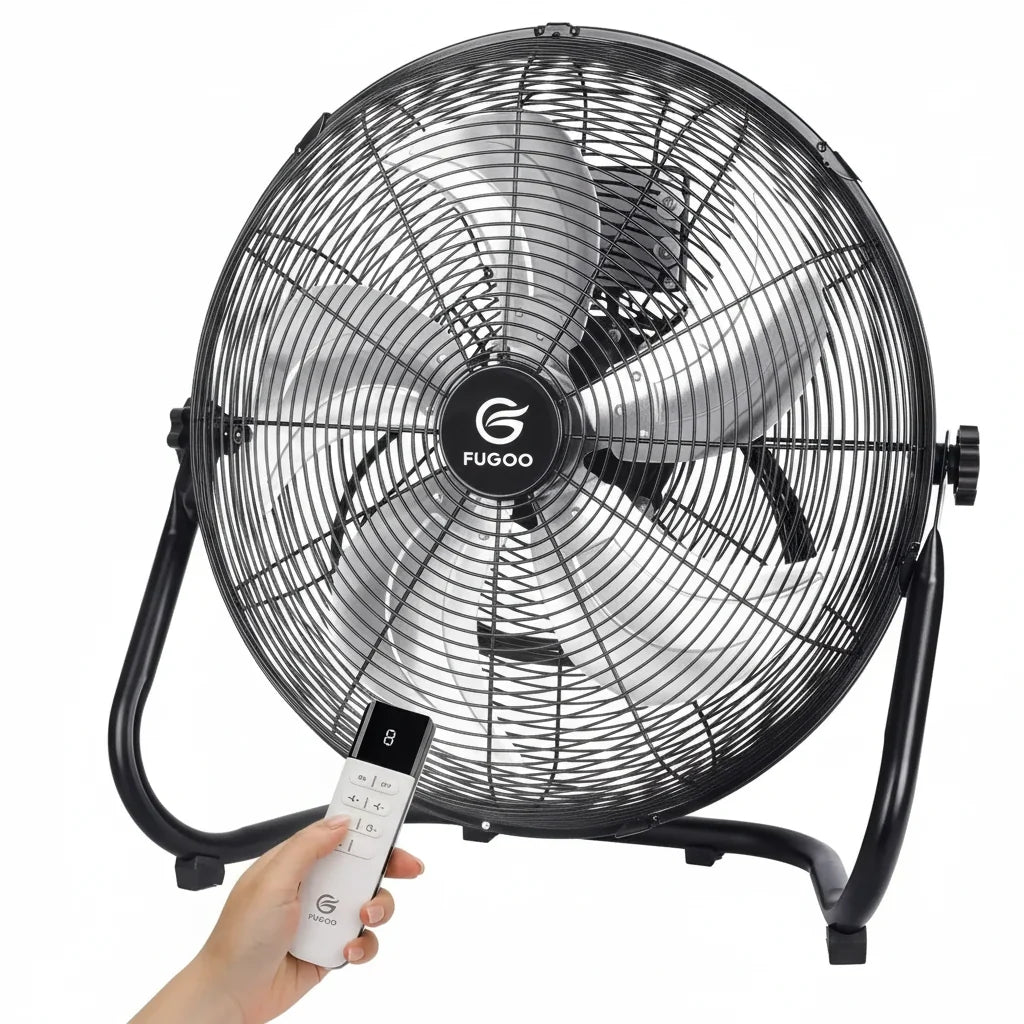
Industrial fan listings often show several numbers at once: CFM, RPM, blade diameter, watts, speed settings, and sometimes noise level. The challenge is knowing which number actually predicts how the fan will perform in a garage, workshop, patio, gym, or warehouse.
The short answer is that no single specification tells the whole story. CFM describes airflow volume, RPM describes rotational speed, and fan diameter describes physical size. Real-world comfort also depends on placement, air velocity, oscillation, obstructions, distance, and the shape of the occupied zone.
This guide explains how to read the specifications together so you can compare industrial fans more intelligently.
Quick answer: which specification matters most?
- Start with CFM when you want to compare the listed volume of air moved.
- Use RPM as supporting information, not as a direct measure of airflow.
- Use fan size to check fit and likely coverage pattern, not to assume performance.
- Check watts and speed settings to understand power requirements and adjustability.
- Evaluate placement and mounting style because even a high-CFM fan performs poorly when blocked or aimed away from the occupied area.
What does CFM mean on a fan?
CFM means cubic feet per minute. It describes the volume of air passing through or moved by a fan in one minute under specified test conditions. A listing of 4,000 CFM therefore represents a much larger airflow volume than 1,000 CFM.
CFM is useful when comparing fans intended for similar applications, but it does not tell you:
- How fast the air will feel at a particular distance.
- How evenly the air spreads across the room.
- How obstacles affect the airflow path.
- How much airflow is produced at lower speed settings.
- Whether the fan is suitable for required ventilation or contaminant control.
A maximum CFM value should be treated as one performance point, not a guarantee that every part of a large room will receive the same airflow.
What does RPM mean on a fan?
RPM means revolutions per minute. It describes how many times the fan's rotating assembly turns in one minute. For example, a listed speed of 1,450 RPM means 1,450 revolutions per minute at the stated operating condition.
Higher RPM does not automatically mean higher CFM. Blade diameter, blade pitch, blade shape, number of blades, guard design, motor power, and system resistance all influence airflow. A larger fan can move more air at a lower rotational speed than a smaller design, while two fans running at the same RPM can have very different CFM ratings.
RPM is most useful when it is evaluated together with the exact fan design and its tested airflow.
What does fan diameter tell you?
Fan diameter—such as 18, 20, 24, or 30 inches—describes the approximate blade or housing class. It helps you understand physical fit, clearance, portability, and the potential width of the airflow pattern.
Diameter alone does not tell you the airflow. In the current FUGOO comparison, the 18-inch floor fan and 20-inch wall or pedestal configurations are both listed at up to 4,000 CFM even though their sizes, mounting styles, speed counts, blade arrangements, and listed RPM differ.
FUGOO example: CFM, RPM, size, and power together
| Configuration | Blade size | Listed RPM | Listed maximum airflow | Listed power | Speed settings |
|---|---|---|---|---|---|
| Portable floor fan | 18 inch | 1,320 RPM | 4,000 CFM | 90 W | 8 |
| Wall or pedestal fan | 20 inch | 1,450 RPM | 4,000 CFM | 75 W | 4 |
| Wall or pedestal fan | 24 inch | 1,450 RPM | 5,000 CFM | 110 W | 4 |
| Wall or pedestal fan | 30 inch | 1,450 RPM | 8,800 CFM | 160 W | 4 |
These are manufacturer-listed values for the compared configurations. Confirm the exact size and product variant before buying. Real-world airflow varies with speed, placement, distance, and obstructions.
What this comparison teaches us
Same CFM does not mean the same experience
The 18-inch floor configuration and 20-inch wall or pedestal configurations share a listed maximum of 4,000 CFM, but they deliver air from different heights and positions. The floor fan is low, tiltable, and portable. Wall and pedestal fans are elevated and oscillating. The better option depends on where the air needs to go.
Same RPM does not mean the same CFM
The compared 20-, 24-, and 30-inch wall and pedestal sizes share a listed 1,450 RPM, while their maximum airflow rises from 4,000 to 5,000 to 8,800 CFM. This shows why RPM cannot be used as a substitute for airflow data.
Larger diameter can support higher airflow, but design still matters
The larger configurations in this comparison have higher listed maximum airflow. However, the relationship is specific to these products. You should not assume every 30-inch fan outperforms every 24-inch fan without comparing tested specifications.
CFM vs. air velocity: why distance matters
CFM is airflow volume. Air velocity describes how fast the air moves at a location. A concentrated stream may feel strong close to the fan but cover a narrower zone. A wider, oscillating pattern can serve more people but may feel less intense at any single point.
As airflow travels away from an open-air circulation fan, it mixes with surrounding air and can be redirected by walls, vehicles, shelves, machinery, and people. That is why a fan's placement often matters as much as the maximum CFM number.
How much CFM do you need?
There is no universal comfort-CFM rule that works for every garage or workshop. Start with the occupied area rather than total building size.
- Mark where people actually need airflow.
- Measure the distance from the proposed fan location.
- Identify obstacles between the fan and the occupied zone.
- Decide whether you need focused directional airflow or broader oscillating circulation.
- Compare CFM, speeds, size, and mounting style.
- Choose a fan that can operate below maximum speed when conditions are mild.
Required ventilation for fumes, combustion products, dust, code compliance, or process control must be designed according to applicable standards. A portable circulation fan is not a substitute for an engineered exhaust or ventilation system.
Choosing specifications for a garage
For a garage workbench or exercise area, targeted airflow may be more useful than trying to circulate the entire garage. An 18-inch floor fan can be moved and tilted toward the occupied zone or an open door.
When vehicles and tools consume the floor area, a wall-mounted fan can keep walkways clear. A pedestal fan works well when the work zone moves between bays. In each case, test the airflow path before assuming that a larger diameter is necessary.
Choosing specifications for a workshop
Workshops often contain shelves, benches, machines, and partitions that break up airflow. Higher CFM may help, but positioning fans on opposite sides of obstructions or using multiple controlled zones can be more effective than one fan operating at maximum speed.
Do not aim circulation fans so they spread sawdust, grinding debris, welding fumes, paint mist, or chemical vapors toward people or occupied rooms. Use required source capture and ventilation equipment for hazardous processes.
Choosing specifications for a warehouse
Warehouses introduce high ceilings, racks, loading doors, large volumes, and changing occupied areas. A single maximum-CFM number is not enough to design the airflow plan.
Consider:
- Ceiling height and total volume.
- Rack orientation and aisle layout.
- Door positions and outdoor conditions.
- Heat-producing equipment and roof heat gain.
- Fixed and temporary occupied zones.
- Required air changes, pressure relationships, and safety standards.
Large or regulated facilities should use a qualified ventilation professional.
Why watts matter alongside CFM
Watts describe electrical power draw at the specified condition. When two fans are being compared for similar duty, watts help estimate operating cost. Dividing airflow by power produces a CFM-per-watt figure, but that simplified ratio should not be treated as a complete efficiency rating across different fan types and operating points.
Compare airflow, power, speed, and intended application together. A fan that looks efficient at maximum speed may not be the best match for the actual duty, distance, or control requirements.
Why speed settings matter
Multiple speed settings make it easier to match airflow to changing conditions. Maximum speed may help with rapid air movement, while a lower setting can be more comfortable for routine work and may use less power.
The number of settings does not prove that one fan is more powerful. It describes control resolution. Compare the airflow and power at the speeds you expect to use whenever that information is available.
What about decibels?
A decibel rating describes measured sound under stated conditions. It should be compared only when the test methods and distances are similar. Room surfaces, mounting, vibration, speed setting, and background noise can change what users hear.
For offices, restaurants, gyms, or residential spaces, sound may be as important as maximum airflow. For louder workshops, placement and communication needs may matter more.
Seven mistakes to avoid when comparing fans
- Choosing by diameter alone. Compare CFM, power, placement, and controls.
- Assuming higher RPM always means more airflow. Fan design changes the result.
- Comparing maximum CFM without considering lower speeds. Most daily use may occur below maximum.
- Ignoring obstructions. A blocked fan wastes useful airflow.
- Using room square footage as the only input. Ceiling height and occupied zones matter.
- Assuming all sizes share the same environmental rating. Confirm each exact variant.
- Using a comfort fan as hazardous-process ventilation. These are different functions.
Frequently asked questions
Is 4,000 CFM enough for a garage?
It can provide strong circulation for many occupied garage zones, but suitability depends on distance, ceiling height, openings, obstructions, heat load, and the airflow goal. It is not a universal ventilation calculation.
Is higher RPM better for a fan?
Not automatically. Higher RPM may contribute to airflow, but blade geometry, size, motor, guard, and system conditions also matter. Compare tested airflow and the intended use.
Does a bigger blade move more air?
A larger blade can support higher airflow, but diameter alone does not guarantee it. Compare the specific fan's CFM, power, RPM, controls, and test conditions.
What is a good CFM-per-watt rating?
There is no single target that applies fairly to every fan type, size, speed, and duty point. Use comparable test data and evaluate the performance needed at the actual operating condition.
Should I buy the fan with the highest CFM?
Only when the space can use that airflow safely and comfortably. A smaller adjustable fan placed correctly may serve the occupied zone better, cost less to run, and create less disturbance.
Final takeaway
CFM is the best starting number for comparing airflow volume, but it is not the whole decision. RPM tells you rotational speed, fan diameter helps determine physical fit and airflow pattern, watts help estimate power use, and speed settings determine how precisely the fan can be adjusted.
Choose the fan that delivers the right airflow to the right place—not simply the highest number on the specification sheet.
Review the FUGOO fan comparison page, explore the 18-inch floor fan, compare the wall-mounted fan range, or view the pedestal fan range.
Share:
How Much Electricity Does an Industrial Fan Use? Running Cost Guide
How to Clean and Maintain an Industrial Fan: A Safety-First Guide