
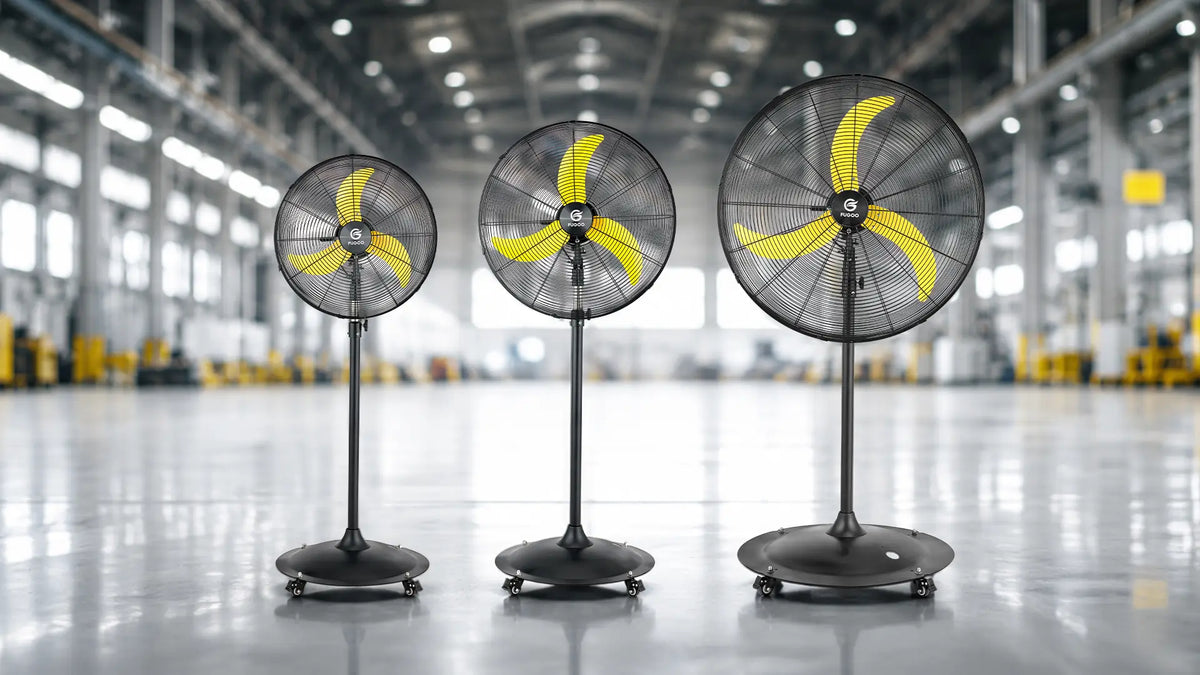
Industrial fans are commonly sold by blade diameter, but a larger diameter does not automatically make a fan the best choice for every garage, workshop, patio, or warehouse. Placement, airflow, power, controls, mounting style, clearance, and the location of the occupied work zone all affect real-world performance.
This guide compares 18-, 20-, 24-, and 30-inch FUGOO fan configurations so you can choose a practical size without relying on diameter alone.
Quick comparison: 18 vs. 20 vs. 24 vs. 30 inches
| Fan size | Available format in this comparison | Listed power | Listed maximum airflow | Best starting point for |
|---|---|---|---|---|
| 18 inch | Portable floor fan | 90 W | 4,000 CFM | Targeted airflow and frequent repositioning |
| 20 inch | Wall-mounted or pedestal fan | 75 W | 4,000 CFM | Compact work zones and everyday circulation |
| 24 inch | Wall-mounted or pedestal fan | 110 W | 5,000 CFM | Larger garages, workshops, and wider occupied areas |
| 30 inch | Wall-mounted or pedestal fan | 160 W | 8,800 CFM | Large commercial areas that need higher-volume air movement |
Specifications above are manufacturer-listed maximum values for the compared configurations. Actual airflow in a room depends on speed setting, distance, obstructions, placement, and installation.
Why diameter is only the first filter
Fan diameter describes the approximate blade or housing class, not the full airflow experience. Two fans with different diameters can have similar maximum CFM ratings, while their mounting positions create very different airflow patterns.
Before choosing a size, answer these questions:
- Do you need focused airflow at one workstation or circulation across a wider area?
- Can the fan remain in one place, or must it move between zones?
- Is floor space available, or should equipment stay above the work area?
- Will shelves, vehicles, machines, or walls block the airflow path?
- Is the selected model specifically rated for the environment where it will operate?
When an 18-inch floor fan makes sense
An 18-inch high-velocity floor fan is a strong option when portability and directional control matter more than wide-area oscillation. The compared FUGOO floor model is listed at 90 watts and up to 4,000 CFM, with eight speed settings and a tilting head.
It can be a practical fit for:
- A garage workbench that changes position.
- Targeted airflow while exercising or performing a task.
- Moving air toward an open door or window.
- Drying a localized surface when the environment is appropriate.
- Users who want more speed increments for fine adjustment.
The low profile is easy to reposition, but nearby boxes, vehicles, walls, and workbenches can restrict the intake or discharge. Leave clear space around the fan and keep walkways and electrical cords safe.
When a 20-inch fan is the balanced choice
The 20-inch wall and pedestal configurations in this comparison are listed at 75 watts and up to 4,000 CFM. That makes 20 inches a useful starting point for buyers who want the same listed maximum airflow as the 18-inch floor model but prefer elevated, oscillating circulation.
Choose a 20-inch wall fan when saving floor space and keeping airflow above benches or equipment are priorities. Choose the pedestal version when you need an elevated fan that can move between work zones.
The compared 20-inch wall and pedestal variants list an IP53 rating. Always confirm the exact rating of the selected product and follow the installation and electrical requirements; an IP rating does not make every location or connection suitable.
When to step up to a 24-inch fan
The compared 24-inch wall and pedestal configurations are listed at 110 watts and up to 5,000 CFM. This intermediate size can be a good fit when a 20-inch fan does not provide enough reach or volume, but a 30-inch model would be difficult to place.
Consider 24 inches for:
- A two-car garage with a defined occupied zone.
- A medium workshop with benches or machinery that interrupt airflow.
- A covered work area where elevated oscillation is useful.
- A commercial space that needs more circulation than a compact setup provides.
The compared 24-inch wall and pedestal variants also list IP53. Verify the specific product, mounting surface, outlet protection, clearances, and local requirements before installation.
When a 30-inch fan is appropriate
The 30-inch wall and pedestal configurations are listed at 160 watts and up to 8,800 CFM. The large increase in listed airflow can help move air across larger commercial or industrial areas, but the fan also needs more physical clearance and careful placement.
A 30-inch model may suit:
- Large workshops or warehouse work zones.
- Wide areas where smaller fans leave persistent stagnant spots.
- Applications where high-volume circulation is more important than compact size.
Do not choose 30 inches only because it has the highest number. Excessive airflow can disturb papers, packaging, dust, or light materials, and a larger fan may be uncomfortable when positioned too close to people. The comparison page does not list an IP rating for the 30-inch variants, so do not assume the environmental rating of the 20- or 24-inch versions applies.
Choose the mounting format after choosing the airflow goal
Floor fan: focused and portable
A floor fan is easy to aim toward a door, a damp surface, or a specific occupied area. It is well suited to changing layouts, but it uses floor space and requires cord management.
Wall-mounted fan: permanent and space-saving
A wall-mounted fan keeps the floor clear and can circulate air above obstacles. It requires a structurally suitable mounting location, safe electrical access, and enough clearance for the full oscillation path.
Pedestal fan: elevated and movable
A pedestal fan raises the airflow and can be moved when the work zone changes. Check the base dimensions, wheel or caster path, stability, ceiling clearance, and storage space.
Measure the space before buying
Product dimensions help determine whether the fan will fit, but also allow room for airflow and movement. The compared product dimensions are:
- 18-inch floor fan: approximately 9.45 D × 23.43 W × 23.82 H inches.
- 20-inch wall fan: approximately 10 D × 22 W × 32 H inches.
- 24-inch wall fan: approximately 10 D × 26 W × 32 H inches.
- 30-inch wall fan: approximately 10 D × 32 W × 40 H inches.
- 20-inch pedestal fan: approximately 22 D × 22 W × 56 H inches.
- 24-inch pedestal fan: approximately 24 D × 26 W × 74 H inches.
- 30-inch pedestal fan: approximately 27 D × 32 W × 56 H inches.
Measure doorways, wall width, ceiling height, mounting clearances, and the distance from the fan to people. For oscillating models, include the complete sweep rather than measuring only the stationary housing.
How to think about CFM
CFM means cubic feet per minute and describes airflow volume under the manufacturer's test conditions. It is useful for comparison, but it does not guarantee uniform coverage in a real room.
Ceiling height, open doors, shelving, machinery, fan angle, speed, and distance all change the result. If the goal is code-required ventilation or removal of hazardous contaminants, use a properly designed ventilation system. A circulation fan should not be selected as a substitute for required exhaust, make-up air, dust collection, or fume control.
A simple decision guide
- Start with the occupied zone. Mark where people actually work or need airflow.
- Decide whether the fan must move. Choose floor or pedestal for mobility, wall mount for a fixed space-saving installation.
- Map the airflow path. Identify doors, windows, obstructions, and stagnant zones.
- Compare listed airflow and speed control. More speed settings can make a fan easier to tune for changing conditions.
- Measure the installation area. Include the base, guard, tilt, oscillation, cord, outlet, and service clearance.
- Confirm the exact model rating. Do not apply one variant's environmental rating to another size.
- Test placement before maximizing speed. Moving or angling the fan may improve the result more than simply choosing the highest setting.
Frequently asked questions
Is a 24-inch fan always better than a 20-inch fan?
No. The 24-inch configurations in this comparison list higher maximum airflow, but a 20-inch fan may fit the space better, use less listed power, and provide sufficient circulation for a compact occupied zone.
Can an 18-inch fan move as much air as a 20-inch fan?
In this comparison, the 18-inch floor model and 20-inch wall or pedestal models are all listed at up to 4,000 CFM. Their airflow pattern, speed controls, height, oscillation, and placement differ, so select by use case rather than diameter alone.
How large a fan do I need for a warehouse?
Warehouse size alone is not enough to choose a fan. Ceiling height, heat load, racks, doors, occupied zones, required air changes, and safety requirements all matter. Large or regulated facilities should use a qualified ventilation professional.
Does a bigger fan use more power?
In the compared wall and pedestal range, listed power rises from 75 watts at 20 inches to 110 watts at 24 inches and 160 watts at 30 inches. Actual energy use depends on the chosen speed and operating time.
Which size is best for a garage?
An 18-inch floor fan works well for portable targeted airflow. A 20-inch wall or pedestal fan can serve a compact garage zone, while a 24-inch option may suit a larger garage with more obstructions. A 30-inch model should be chosen only when the space, clearance, and airflow requirement justify it.
Final takeaway
Choose an industrial fan by airflow goal, placement, and clearance—not by diameter alone. An 18-inch floor fan offers portable targeted airflow; 20-inch wall and pedestal fans balance compact size with elevated circulation; 24-inch models provide a step up in listed airflow; and 30-inch models serve larger areas where their size and output can be used safely.
Review the FUGOO fan comparison, explore the 18-inch floor fan, compare the wall-mounted fan range, or view the pedestal fan range before deciding.
Share:
How to Improve Garage Airflow and Cooling Without AC
Wall-Mounted Fan vs. Pedestal Fan: Which One Should You Choose?