
A garage can become one of the hottest and most uncomfortable spaces around a home. Heat from the roof, limited windows, parked vehicles, tools, appliances, and poor air movement can create stagnant zones even when the garage door is open.
Air conditioning is not always practical or necessary. In many garages, better airflow, shade, insulation, and correctly positioned fans can improve comfort. This guide explains how to create a more effective garage-airflow plan without treating a circulation fan as a substitute for required ventilation.
First, understand the difference between cooling and airflow
A fan does not lower air temperature in the same way as an air conditioner. It moves air. That movement can help people feel more comfortable, reduce stagnant hot spots, support evaporation, and move indoor air toward an opening.
The best results come from combining air movement with heat control and a clear path for air to enter and leave the garage.
1. Create a cross-ventilation path
Cross-ventilation uses an opening on one side of the space for incoming air and another opening for outgoing air. Depending on the garage layout, this may involve the main door, a side door, a window, or a purpose-built vent.
- Open two separated points when outdoor conditions are suitable.
- Keep boxes, shelving, vehicles, and curtains away from the airflow path.
- Place a fan near one opening to help move warm indoor air out.
- Allow replacement air to enter from the opposite side.
If there is only one opening, aim the fan so it helps exchange air rather than simply blowing the same hot air around the center of the garage.
2. Position the fan strategically
Fan placement can matter as much as fan size. Test more than one position before assuming that the highest speed is required.
- For exhaust support: Place the fan several feet inside the open garage door and aim it outward.
- For personal comfort: Direct airflow across the occupied work area without blowing dust or debris toward the operator.
- For whole-space circulation: Angle the fan slightly upward to help mix warmer ceiling air with cooler air below.
- For drying: Aim airflow across the damp surface instead of directly downward.
Keep the intake and front guard clear. Walls, workbenches, vehicles, and storage placed too close to the fan can restrict airflow.
3. Choose the right fan format
Portable floor fan
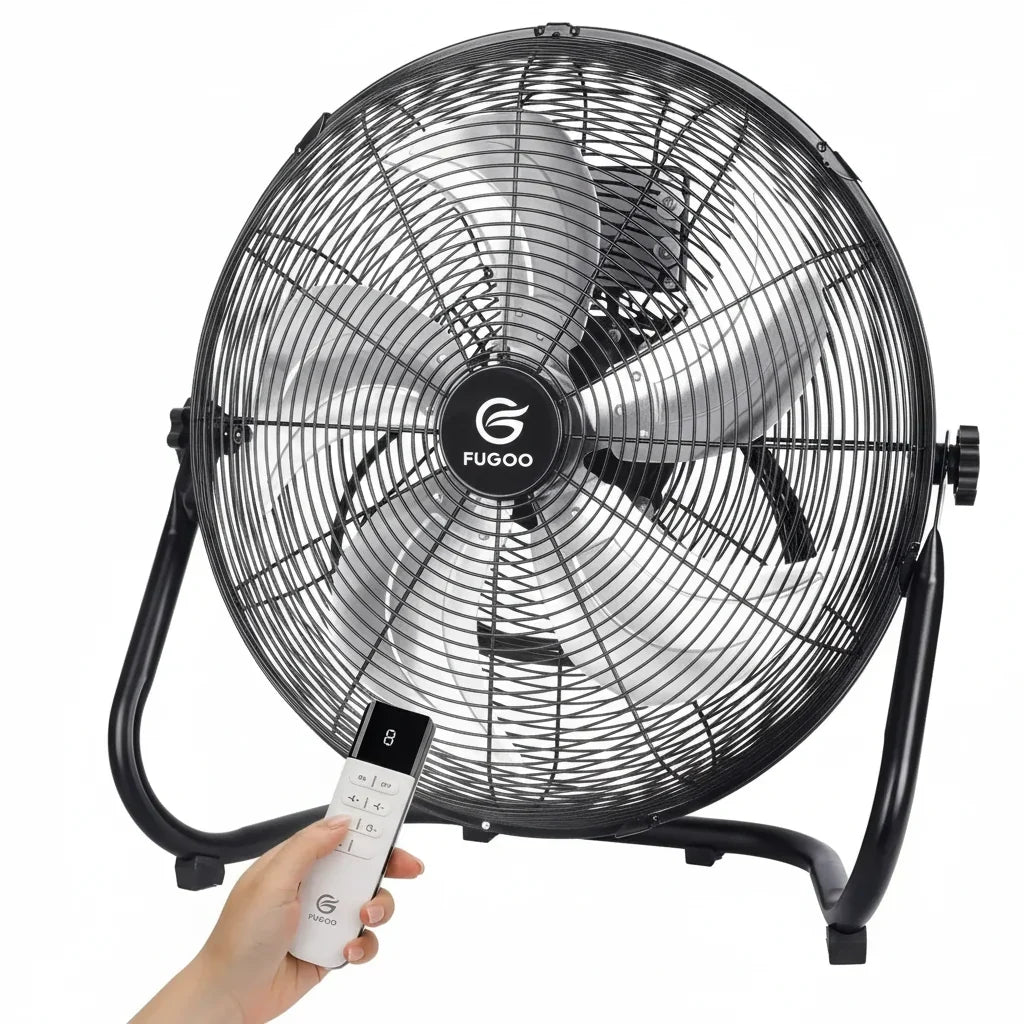
A high-velocity floor fan is useful when airflow needs to be redirected frequently. Its low position works well for targeted cooling, pushing air toward a door, or supporting floor-drying tasks. FUGOO's 18-inch floor fan is listed at 90 watts with airflow up to 4,000 CFM and eight speed settings.
Pedestal fan
A pedestal fan raises airflow above low obstacles and can be moved between work zones. A wheeled base is useful in garages where vehicles, tools, or projects change position. Oscillation can spread air across a wider occupied area.
Wall-mounted fan
A wall fan saves floor space and keeps walkways clear. It is a practical option for permanent airflow above a workbench or across a garage bay. Installation requires a structurally suitable mounting point, safe electrical access, and clearance for the complete oscillation path.
4. Match airflow to the occupied zone
Do not choose a fan based only on the total square footage of the garage. Consider ceiling height, door position, shelving, vehicles, heat-producing equipment, and where people actually work.
Airflow is commonly measured in cubic feet per minute (CFM), but maximum CFM is only one part of the decision. A fan with multiple speeds may provide better control than a fan that is comfortable only at its lowest or highest setting.
5. Reduce heat before moving it
Fans work better when the garage is not absorbing unnecessary heat. Depending on the building and climate, useful steps may include:
- Adding appropriate insulation to the garage door or ceiling.
- Using exterior shade where permitted.
- Sealing unwanted gaps while preserving required ventilation.
- Turning off lights, chargers, compressors, or equipment that are not being used.
- Parking a hot vehicle outside until it has cooled when practical.
- Scheduling heat-producing work for cooler parts of the day.
6. Use speed settings efficiently
Maximum speed is helpful for rapid air exchange or intense heat, but it may not be necessary all day. Start at a moderate setting, observe how the air moves, and increase speed only when needed.
A BLDC fan with several electronic speed settings can make this adjustment easier. Lower settings may be sufficient for routine circulation, while higher settings can support faster air exchange when doors are open.
7. Keep dust and fumes in mind
Air movement can spread sawdust, grinding particles, paint mist, chemical vapors, or vehicle exhaust. A circulation fan does not remove these hazards by itself.
- Never run a vehicle engine in an enclosed garage.
- Use required local exhaust and dust collection for the task.
- Do not aim a fan so it blows contaminants toward people or occupied rooms.
- Follow product labels and safety requirements for fuels, solvents, coatings, and batteries.
- Use qualified professional ventilation when hazardous fumes or combustible dust may be present.
8. Protect the electrical connection
Garage floors may become wet, cords may cross traffic areas, and outlets may be exposed to demanding conditions. Keep plugs and controls dry, avoid damaged extension cords, and use outlets and protection appropriate for the location.
Weather resistance varies by fan model and size. Confirm the exact rating for the selected variant instead of assuming that every fan is suitable for damp or outdoor use.
9. Maintain clear, clean airflow
Dust on the guard and blades can restrict airflow and create imbalance. Disconnect power before cleaning or moving the fan. Follow the manufacturer’s instructions, inspect the cord and plug, and make sure bases, wheels, brackets, and adjustment points remain secure.
A simple garage-airflow setup
- Open the main door and a separated window or side door when conditions allow.
- Remove obstacles from the intended airflow path.
- Place a portable fan inside the garage and aim it toward the main opening.
- Use a pedestal or wall fan to circulate air across the occupied work zone.
- Start at a moderate speed and check whether air reaches the intended area.
- Adjust the fan angle or location before increasing to maximum speed.
- Stop and reassess if the setup spreads dust, fumes, or debris.
Frequently asked questions
Should a garage fan blow inward or outward?
It depends on the goal and available openings. Blowing outward can help remove accumulated warm air when replacement air can enter elsewhere. Blowing inward can deliver outdoor air to an occupied zone. Test both arrangements and keep a clear path for air exchange.
How many CFM does a garage need?
There is no universal number for comfort circulation. Garage volume, heat load, openings, layout, and the occupied area all matter. Required ventilation for fumes or code compliance must be designed according to applicable standards, not selected only from a portable-fan CFM rating.
Can a fan cool a closed garage?
It can reduce stagnant zones and improve comfort, but it will not remove the accumulated heat like air conditioning or an effective exchange with cooler outdoor air.
Can I leave a garage fan running unattended?
Only if the specific fan is approved for that use and the environment is safe. Follow the operating manual, keep clearances around the fan, and never leave damaged electrical equipment running.
Can a fan remove vehicle exhaust?
A general circulation fan is not a safe substitute for a properly designed exhaust system. Never idle a vehicle in an enclosed garage.
Final takeaway
Improving garage comfort without air conditioning starts with a clear airflow path, correct fan placement, reduced heat gain, and safe ventilation practices. Choose a floor fan for portable directional airflow, a pedestal fan for elevated mobility, or a wall fan when saving floor space is the priority.
Before buying, compare airflow, speed settings, power, placement, controls, construction, and environmental rating. The best fan is the one that serves the occupied area safely—not simply the largest model available.
View the FUGOO high-velocity floor fan, explore the oscillating pedestal fan, or see the wall-mounted fan range.
Share:
How to Choose an Industrial Pedestal Fan for Large Spaces
18 vs. 20 vs. 24 vs. 30-Inch Industrial Fans: Which Size Do You Need?