
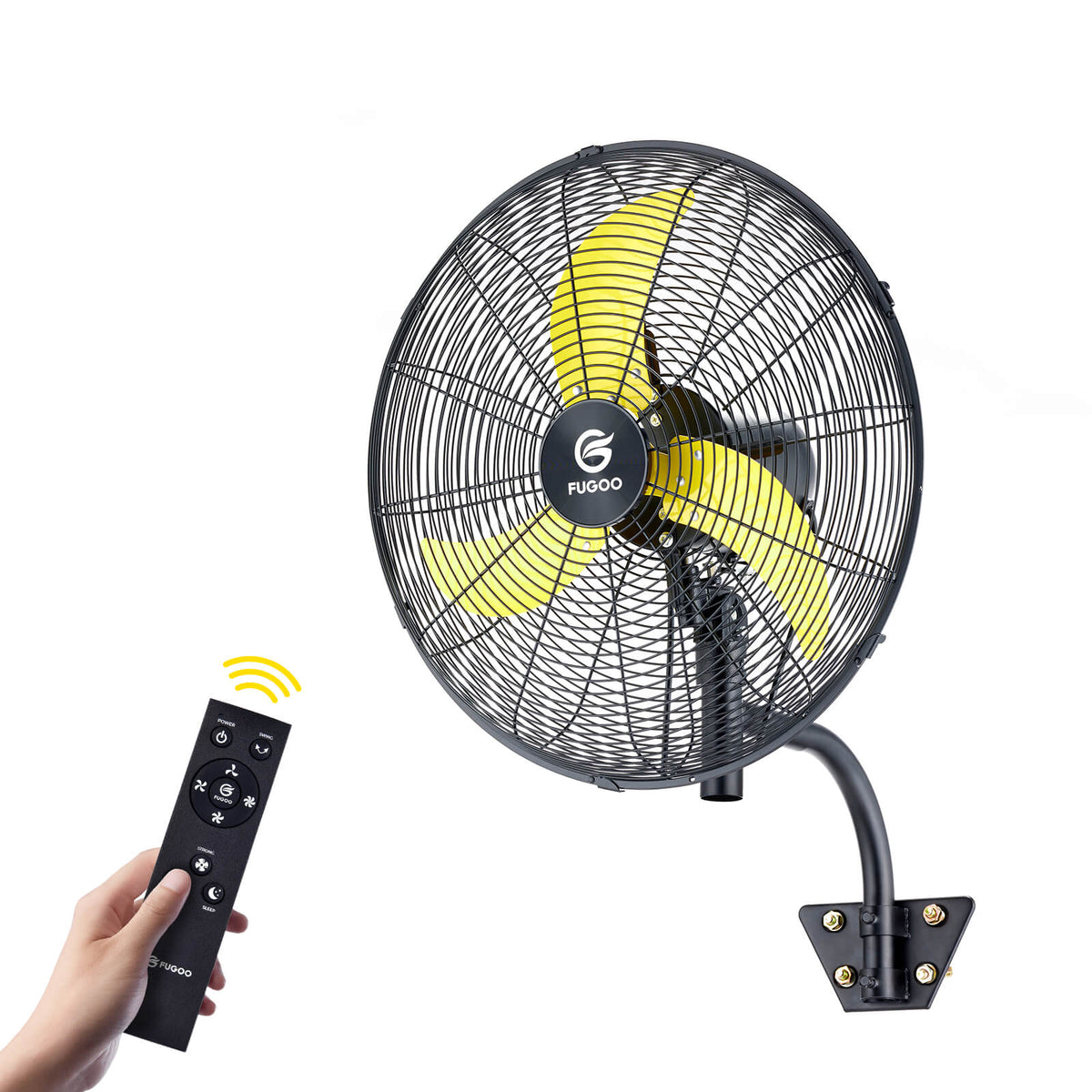
When choosing a fan for a garage, workshop, warehouse, patio, gym, or commercial space, blade size and airflow usually receive the most attention. The motor matters just as much. It affects speed control, power consumption, operating sound, maintenance expectations, and the overall user experience.
Two common categories are brushless DC (BLDC) fans and traditional AC-motor fans. Neither label automatically guarantees that a product is right for every space. This guide explains the practical differences and shows what to compare before buying.
What is a BLDC fan?
A BLDC fan uses a brushless direct-current motor with electronic controls that switch current through the motor windings. Because there are no mechanical brushes making contact inside the motor, speed can be managed electronically across a wider range.
Many modern BLDC fans still plug into a standard household AC outlet. Internal electronics convert and control the power required by the motor, so the term BLDC describes the motor system rather than the type of wall outlet.
What is a traditional AC fan?
A traditional AC fan uses a motor designed to run from alternating current. AC-motor fans are widely available, and simple models can be straightforward and economical. Depending on the design, speed may be controlled through fixed windings, capacitors, transformers, or electronic controllers.
The important comparison is not simply “DC is good and AC is bad.” Build quality, motor design, blade shape, guard restriction, controls, and the required airflow all affect real-world performance.
BLDC vs. AC fan: the main differences
1. Speed control
BLDC motors are well suited to electronic speed control. This can provide smoother changes and more usable settings between minimum and maximum airflow. Some AC fans offer only a few fixed speeds, although higher-end AC designs can also provide sophisticated control.
2. Power consumption
A well-designed BLDC fan can deliver strong airflow while using power efficiently, especially when operated below maximum speed. However, the motor label alone is not enough to estimate savings. Compare rated watts, airflow at each speed, and how many hours the fan will run.
3. Operating sound
Motor noise can be lower in a properly designed BLDC system because electronic commutation replaces mechanical brushes. Total sound still depends on blade speed, blade shape, guard design, vibration, mounting, and airflow turbulence. At high airflow, moving air itself can be the dominant sound.
4. Heat and long operating periods
Efficient motors waste less input energy as heat. This can be useful for fans that operate for many hours, but continuous-duty suitability must be confirmed in the manufacturer's instructions. Never assume that every BLDC or AC fan is approved for unattended or round-the-clock operation.
5. Controls and convenience
BLDC systems commonly integrate remote controls, timers, oscillation controls, and multiple speeds. These features are convenient in large spaces where the fan is mounted high or positioned away from the operator. Comparable features may also be available on AC fans, so check the actual control set.
6. Purchase price and value
BLDC fans may cost more initially because of their motor electronics and control system. The better value depends on operating hours, electricity cost, required airflow, noise expectations, warranty, and how often the controls will be used.
How to compare fan efficiency correctly
Do not judge efficiency from wattage alone. A low-watt fan that moves too little air may not meet the job, while a higher-power fan could serve a much larger area. Consider these figures together:
- CFM: Cubic feet of air moved per minute.
- Watts: Electrical power consumed at a stated setting.
- CFM per watt: A useful comparison when ratings are measured under comparable conditions.
- Operating hours: The amount of time the fan runs each day or year.
- Electricity rate: The local cost per kilowatt-hour.
Simple operating-cost formula
Use this estimate to compare two fans:
Estimated cost = (watts ÷ 1,000) × operating hours × electricity rate per kWh
For example, a 110-watt fan running for 8 hours uses approximately 0.88 kWh before accounting for variations between speed settings. Multiply that figure by your electricity rate to estimate the daily cost. For a fair comparison, use power consumption at the speed that provides the airflow you actually need.
Examples from the current FUGOO range
FUGOO's current comparison page lists BLDC motors across its high-velocity floor, oscillating wall-mount, and pedestal fan ranges. This means customers can choose the mounting style according to the space without giving up electronic speed control.
- 18-inch floor fan: 90 watts, up to 4,000 CFM, eight speed settings, and portable directional airflow.
- Wall-mount range: 20, 24, and 30-inch options with four speeds, oscillation, and remote controls.
- Pedestal range: 20, 24, and 30-inch options with four speeds and a movable wheeled base.
Specifications vary by size. Always review the selected variant instead of assuming that every size has the same airflow, power, dimensions, or environmental rating.
Which motor is better for each use case?
Garage or home workshop
A BLDC fan can be useful when you want several speed settings, remote control, and frequent operation. A simple AC fan may still be sufficient when it runs occasionally and only one or two airflow levels are needed.
Warehouse or commercial area
Focus first on airflow coverage, placement, durability, and operating schedule. When several fans run for long shifts, power consumption and control flexibility become more important to total ownership cost.
Covered patio or humid area
Motor type does not determine weather resistance. Confirm the exact IP rating, installation requirements, outlet protection, and permitted environment for the selected model and size.
Bedroom, office, or quiet workspace
Look for verified sound information at the speeds you expect to use. A BLDC motor can support quiet low-speed operation, but blade and airflow noise still matter. A maximum sound rating does not describe every speed.
Buying checklist
- Define the occupied area and where airflow needs to reach.
- Choose floor, pedestal, or wall mounting according to available space and mobility needs.
- Compare CFM and watts at relevant speeds, not only maximum values.
- Check the number of speeds, remote functions, oscillation, and tilt.
- Confirm voltage, plug type, cord placement, and outlet capacity.
- Verify the exact environmental or IP rating for the selected variant.
- Review construction, guard design, mounting hardware, warranty, and replacement-part support.
- Estimate annual running cost using realistic daily operating hours.
Frequently asked questions
Does a BLDC fan always use less electricity?
Not automatically. Motor efficiency is only one part of the system. Compare measured power and airflow at the speed you need. A larger BLDC fan at maximum output may use more power than a small AC fan while also moving substantially more air.
Does BLDC mean the fan requires a DC outlet?
No. Many BLDC fans connect to a normal AC outlet and use internal electronics to operate the motor.
Are BLDC fans always quieter?
They can reduce some motor-related noise, particularly at lower speeds, but total noise also comes from blades, airflow, guards, vibration, and installation.
Can a BLDC fan run continuously?
Only if the specific product is designed and approved for that duty. Follow the manufacturer's operating instructions and electrical-safety guidance.
Can any circulation fan replace ventilation equipment?
No. A fan that circulates room air should not replace required exhaust, filtration, or professional ventilation for smoke, fumes, dust, chemicals, or hazardous materials.
Final takeaway
A BLDC fan is often a strong choice when you value precise speed control, convenient electronics, and efficient performance across long operating periods. A traditional AC fan can remain practical for occasional use, simple controls, or a lower initial budget.
The right decision comes from comparing airflow, watts, controls, placement, construction, environmental suitability, operating hours, and total cost—not from the motor label alone.
Compare FUGOO fan models or view the FUGOO BLDC oscillating wall-mount fan.
Share:
How to Choose a Wall-Mount Fan for Garages, Patios, and Workshops
How to Choose an Industrial Pedestal Fan for Large Spaces