
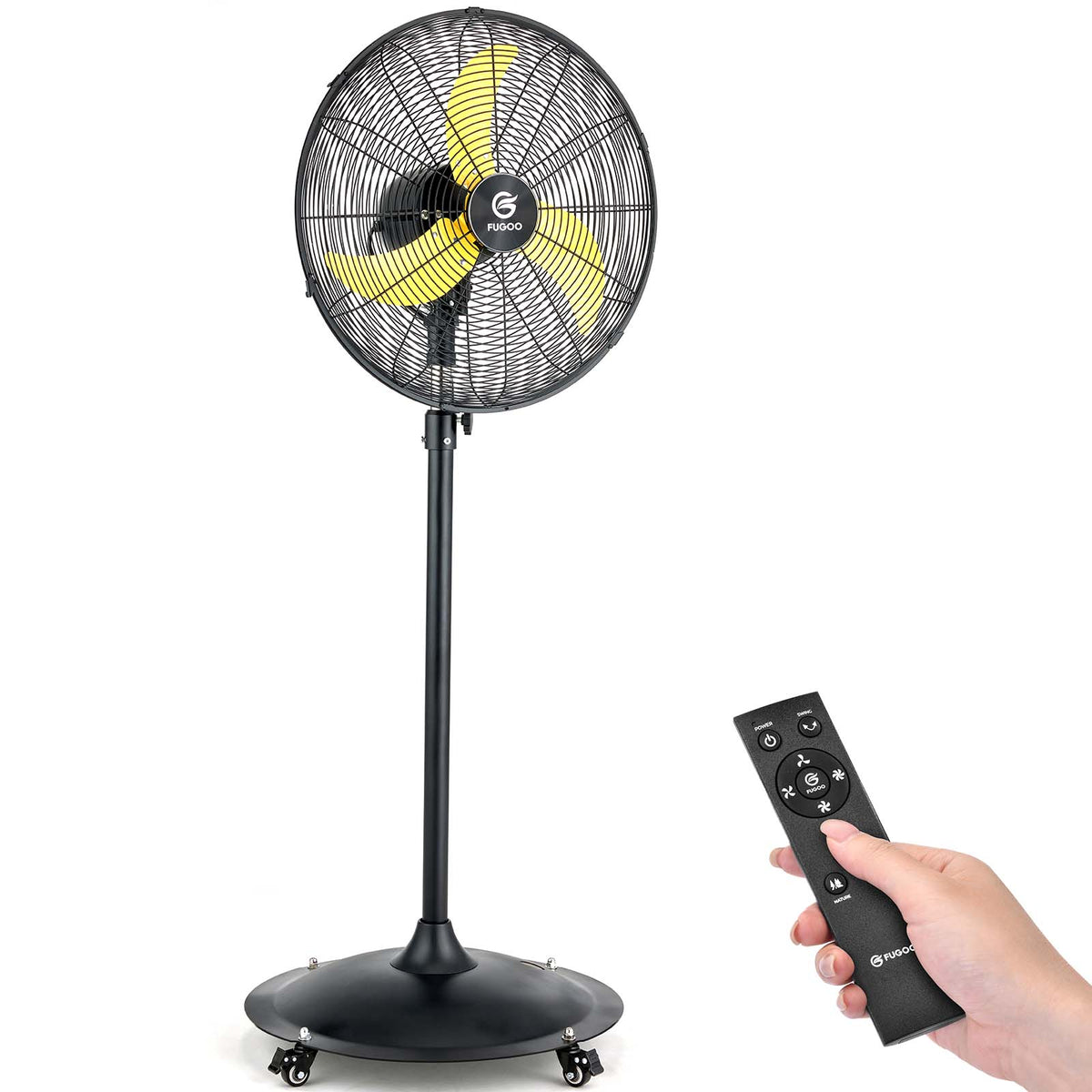
A powerful fan can make a garage, workshop, patio, gym, or commercial space more comfortable, but permanently mounting a fan is not always practical. An industrial pedestal fan combines elevated airflow with the flexibility to move the unit when the layout or work area changes.
This guide explains how to choose a pedestal fan, how blade size and airflow affect performance, and when a pedestal model makes more sense than a floor or wall-mounted fan.
What is an industrial pedestal fan?
A pedestal fan places the fan head above the floor on a stand or wheeled base. This elevated position helps direct airflow across people, workstations, tables, vehicles, and equipment. Industrial-style models typically use metal construction, larger blades, stronger motors, and wider airflow coverage than compact household fans.
Common applications include garages, workshops, warehouses, restaurants, fitness areas, stores, covered patios, and other medium-to-large spaces.
Why choose a pedestal fan?
- Move it as needs change: A wheeled base makes it easier to reposition the fan between work zones.
- No wall installation: It can be used without drilling holes or choosing a permanent mounting point.
- Elevated airflow: The fan head sends air above floor-level obstacles.
- Wide coverage: Oscillation helps distribute air across a broader area.
- Flexible seasonal use: The fan can be stored or moved indoors when conditions change.
Seven features to compare before buying
1. Blade diameter
Larger blades can move more air but require more space. Measure both the fan's footprint and the clearance needed around the oscillating head. A 20-inch fan may suit a garage or focused work area, while 24-inch and 30-inch models are intended for progressively larger spaces.
2. Airflow capacity
Airflow is commonly measured in cubic feet per minute (CFM). FUGOO's current model comparison lists up to 4,000 CFM for the 20-inch pedestal fan, 5,000 CFM for the 24-inch version, and 8,800 CFM for the 30-inch version. These ratings help compare models, but actual room performance depends on fan speed, placement, ceiling height, obstructions, and available ventilation.
3. Motor and power use
A brushless DC (BLDC) motor provides precise speed control and is designed for efficient operation. The listed rated power differs by size: 75 watts for the 20-inch model, 110 watts for 24 inches, and 160 watts for 30 inches. Compare airflow and power together to find an appropriate balance for your space.
4. Speed settings
Multiple speeds let one fan handle different tasks. Lower settings can maintain everyday circulation, while higher settings can provide stronger cooling during hot periods or high-activity work. The current FUGOO pedestal range provides four speed settings.
5. Oscillation and tilt
Oscillation sweeps airflow across the room instead of concentrating it in a single direction. Vertical tilt helps aim air toward seated occupants, standing workers, or a particular work zone. FUGOO's pedestal fan provides 90-degree horizontal oscillation and manual vertical adjustment.
6. Controls and mobility
Remote control is useful when the fan sits across a large room. A stable wheeled base makes relocation easier, but wheels should lock securely before operation. Also check the handle, cord length, overall dimensions, and route between the places where the fan will be used.
7. Materials and environmental suitability
Metal guards, alloy-steel construction, and aluminum blades suit demanding workspaces. If the fan will be used on a covered patio or in a humid garage, verify the exact protection rating for the selected size. FUGOO's comparison page lists IP53 protection for the 20-inch and 24-inch variants, while the 30-inch variant is not listed with that rating.
20-inch vs. 24-inch vs. 30-inch pedestal fans
| Size | Rated power | Maximum listed airflow | Typical use |
|---|---|---|---|
| 20 inch | 75 W | 4,000 CFM | Garages, home gyms, smaller workshops, targeted cooling |
| 24 inch | 110 W | 5,000 CFM | Larger workshops, patios, stores, medium commercial spaces |
| 30 inch | 160 W | 8,800 CFM | Warehouses and large industrial or commercial areas |
Choose based on the occupied area rather than total square footage alone. A smaller fan placed correctly can be more useful than a larger fan blocked by shelving or equipment.
Pedestal fan vs. floor fan vs. wall fan
- Pedestal fan: Best when elevated airflow and mobility are both important.
- Floor fan: Best for low-level directional airflow, portable spot cooling, and floor-drying tasks.
- Wall fan: Best when saving floor space and maintaining a permanent airflow zone are priorities.
If the fan must move between a garage, workshop, patio, or training area, a pedestal model with wheels usually offers the most flexibility. If floor space is extremely limited, a wall-mounted model may be more suitable.
Placement tips for better airflow
- Keep the intake clear. Leave space behind the fan so it can draw air without being blocked by a wall, curtain, box, or shelf.
- Use the oscillation path. Position the fan where its sweep reaches the occupied area instead of wasting airflow on an empty wall.
- Lock the wheels. The base should remain stable before the fan is switched on.
- Aim slightly upward when needed. A modest upward angle can help mix layers of air in a high-ceiling space.
- Support cross-ventilation. When outdoor conditions are suitable, use the fan with an open door or window to help exchange indoor air.
- Protect the power connection. Do not stretch the cord across walkways or use the fan where water can exceed the model's rating.
Cleaning and maintenance checklist
- Disconnect power before cleaning, moving, or inspecting the fan.
- Remove dust from the guard and blades according to the product manual.
- Check that base fasteners, wheels, and adjustment points remain secure.
- Inspect the cord and plug for damage before use.
- Keep the motor housing and controls dry.
Frequently asked questions
Does an industrial pedestal fan cool the air?
A fan circulates air but does not lower its temperature like an air conditioner. Moving air can improve comfort and reduce stagnant hot spots.
Can I use a pedestal fan outdoors?
Only when the exact model and size are rated for the intended environment. The current FUGOO comparison information lists IP53 protection for the 20-inch and 24-inch variants, but not the 30-inch version. Weather resistance does not mean submersible, and the outlet and electrical connection still need suitable protection.
Is a larger fan always better?
No. A larger fan uses more space and power and may produce more airflow than a smaller area needs. Select the size that matches the occupied zone, available clearance, and operating conditions.
Can a pedestal fan replace required ventilation?
No. A circulation fan should not replace professional exhaust, filtration, or ventilation controls for smoke, dust, fumes, chemicals, or hazardous materials.
Where should I place the fan in a garage?
Place it on a level surface with a clear intake and aim it across the working area or toward an open door when using cross-ventilation. Keep the cord away from vehicles, tools, wet surfaces, and walkways.
Final takeaway
An industrial pedestal fan is a strong choice when you need wide, elevated airflow without committing to a permanent wall installation. Compare blade size, CFM, motor type, power, speed settings, oscillation, base stability, and environmental rating before buying.
For most garages and workshops, a 20-inch or 24-inch model provides a practical balance of airflow and mobility. A 30-inch fan is better suited to larger facilities after confirming space, electrical, and environmental requirements.
Share:
BLDC vs. AC Fans: Which Motor Is Better for Large Spaces?
How to Improve Garage Airflow and Cooling Without AC